
Are Cheaper AI Accelerators Worth the Software Migration Effort?
Cheaper AI accelerators are worth the software migration effort when their lower operating cost survives three tests: the workload meets its performance and accuracy requirements, the software remains maintainable, and the savings repay migration before the deployment changes again. A lower purchase price alone establishes none of these conditions.
The strongest candidates are stable workloads with supported operators, predictable memory requirements, and enough sustained utilization to recover engineering costs. The weakest candidates rely on specialized kernels, rapidly changing model architectures, or tightly coupled distributed training. Start with a representative workload and a measurable acceptance threshold before comparing hardware quotations.
Establish what the current system actually costs to deliver
Define the unit of useful work first. For inference, this might be a completed request that meets both quality and latency requirements. For training, use the cost of reaching a specified model quality, including unsuccessful runs and recovery time. Advertised compute throughput does not establish either measure.
An inference service needs more than an average tokens-per-second result. Record input and output lengths, concurrent requests, time to first token, subsequent token delivery, and tail latency. A system that processes more tokens in a large batch can still perform poorly when interactive requests arrive unevenly.
For training, capture step time after warm-up, memory consumption, communication overhead, checkpoint duration, and restart behavior. Faster individual steps provide limited value if numerical differences require more steps to reach the same quality or unstable runs repeatedly lose progress.
Measure the existing deployment under representative demand. Low utilization caused by slow data loading, CPU preprocessing, storage contention, or overly conservative scheduling will follow the application onto new hardware unless those constraints change. Buying a cheaper accelerator does not automatically reduce the cost of an underused service.
Separate compatibility from a successful demonstration
A model loading successfully proves only that one execution path works. Migration becomes expensive when production exercises unsupported operators, different tensor shapes, custom extensions, or communication paths that the demonstration avoided.
Build a dependency map from the application downward: model framework, compiler or graph conversion, operator libraries, custom kernels, distributed communication, device runtime, and deployment tooling. Record which components run unchanged, which require configuration changes, and which need replacement code. This exposes where migration effort will accumulate.
Inspect fallback behavior explicitly. An unsupported operation that quietly runs on the CPU can leave accelerator utilization looking reasonable while request latency rises. Repeated device-to-host transfers are especially damaging when small operations interrupt an otherwise efficient execution graph.
Dynamic shapes deserve a separate trial. Variable sequence lengths or image sizes can trigger recompilation, require multiple compiled variants, or constrain batching. Include compilation time and cache behavior in the deployment assessment, particularly when services restart frequently or models change often.
Precision support also needs qualification. A device's advertised low-precision throughput is useful only if the model retains acceptable quality with a supported execution path. Quantization introduces calibration, evaluation, and sometimes retraining work. Include that work in migration estimates instead of assuming a lower-precision format is interchangeable with the existing configuration.
Run a pilot that exposes the expensive paths
Select a pilot that represents the workload responsible for a meaningful share of spending. Include its difficult cases: long contexts, peak concurrency, unusual tensor shapes, memory pressure, and the operations that currently require custom code. A convenient demonstration model creates weak evidence for a production decision.
Keep the comparison controlled. Use the same model version, equivalent quality thresholds, comparable request distributions, and documented software versions. Where precision or batching differs, disclose the difference and evaluate its effect. Otherwise, a software optimization can be mistaken for a hardware advantage.
- Establish correctness before tuning. Compare outputs against the existing implementation using task-relevant evaluation data. For training, test convergence behavior rather than expecting identical floating-point results.
- Measure a reproducible baseline, including warm-up, compilation, steady operation, and memory use. Separate startup behavior from sustained throughput so neither disappears inside an average.
- Investigate the largest bottleneck, then rerun the same workload. Keep a record of engineering time and each configuration change; the tuning effort is part of the purchase economics.
- Exercise restart, failed requests, checkpoint recovery, and rollback under load. A performance result is incomplete until the service can recover predictably.
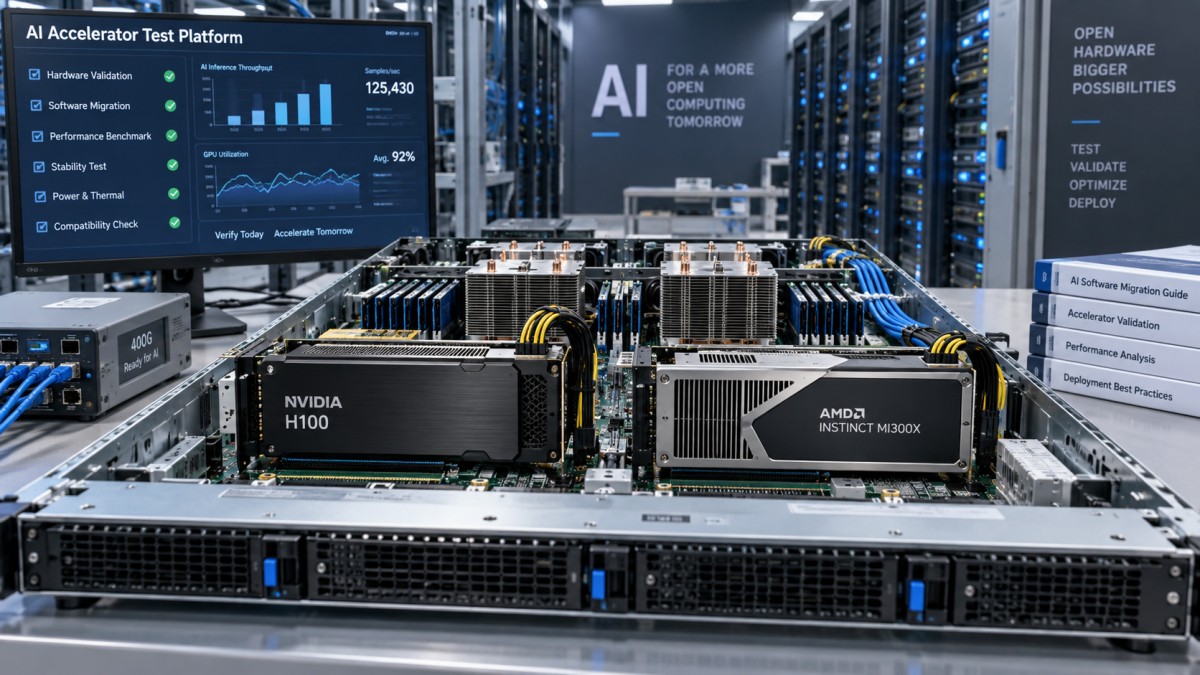
Do not attribute every poor result to the accelerator. The diagnostic logic resembles investigating whether repeated SiC MOSFET failures originate in the gate driver: isolate the suspected cause from interacting conditions before replacing the component. Here, vary one relevant constraint at a time, such as batch size, operator placement, memory pressure, or communication topology. The analogy supports disciplined testing; electrical failure mechanisms do not explain software behavior.
If a model runs slowly because of an unsupported attention implementation, the result establishes a software limitation in the tested configuration. It does not prove that every workload will perform poorly on that device. Conversely, a fast optimized model says little about a portfolio containing different architectures.
Calculate savings after migration and capacity penalties
Compare complete deployable systems. Accelerator price can exclude host servers, memory, network interfaces, interconnect equipment, power provisioning, and integration work. Use equivalent service capacity and availability requirements when constructing both configurations.
Net benefit over the evaluation period = avoided baseline costs − replacement-system costs − migration costs − transition costs.
Replacement-system costs include acquisition, energy, support, software charges where applicable, and ongoing maintenance. Migration costs include porting, validation, tuning, infrastructure integration, and documentation. Transition costs include parallel operation, temporary duplicate capacity, and any disruption supported by evidence from the pilot.
Use accepted throughput to size the replacement. If each device delivers fewer requests within the latency target, more devices are needed, even when their peak throughput appears attractive. That change also affects rack space, host capacity, networking, and power. Memory limits can create a similar penalty by forcing a model across additional devices.
For a stable service, a useful estimate is:
Payback period = upfront migration and transition costs ÷ recurring net savings per period.
The denominator must include ongoing engineering and support differences. If recurring net savings are zero or negative, there is no operating-cost payback. Treat hardware acquisition consistently: either include the acquisition difference in the upfront calculation or account for it across the evaluation period, without counting it twice.
Compare payback with the expected workload lifetime. A migration that repays only after the model, serving stack, or deployment is scheduled for replacement has little economic margin. Test the calculation against lower utilization, slower tuning progress, and less favorable performance. Savings that disappear under a modest change in assumptions need stronger evidence before commitment.
Account for the software work that returns after launch
One-time porting is only part of the burden. Framework updates, new model operators, security patches, and compiler changes can require renewed validation. A migration that depends on maintaining a private framework fork creates a different obligation from one supported through normal upstream releases.
Examine how versions interact. A runtime upgrade may require a matching driver, compiler, container image, or communication library. Reproduce the tested combination from a controlled build and retain a working rollback image. Without this discipline, a successful pilot can become difficult to reproduce during deployment.
Support maturity is observable through concrete mechanisms: documented compatibility matrices, actionable error messages, profiling tools, release notes, known-issue tracking, and a credible process for resolving defects. Ask for evidence involving the operators and deployment configuration actually under evaluation. A broad statement of framework support is insufficient.
Consider how much application logic becomes device-specific. A narrow backend adapter is easier to maintain than hardware assumptions spread across model code, scheduling, and monitoring. However, portability layers have their own limits; verify that they expose the features needed for performance instead of assuming abstraction eliminates engineering work.
Choose the deployment boundary before committing
A selective migration often has a clearer economic case than replacing an entire accelerator fleet. Stable batch inference, embedding generation, or a fixed vision model can be evaluated independently from experimental training. This limits the amount of software that must change and makes cost attribution easier.
That separation still has an operating cost. Multiple backends require additional build artifacts, scheduling rules, capacity planning, monitoring, and regression coverage. Include those obligations in the comparison. A small hardware saving can be consumed by maintaining two production stacks.
Memory capacity and bandwidth can change the preferred boundary. A lower-priced device with sufficient memory for the complete model may avoid distributed execution. A cheaper device with insufficient memory can introduce communication overhead that overwhelms its acquisition advantage. Evaluate weights, activations, temporary buffers, and inference cache together rather than considering model weights alone.
Distributed training needs evidence at the intended scale. Communication overhead, synchronization, checkpoint storage, and recovery behavior emerge across nodes. Extrapolating from a single-device trial understates migration uncertainty, especially when the existing workload already depends on optimized collective operations.
Make the decision with explicit acceptance gates
Approve expansion only when the pilot demonstrates acceptable quality, required service performance, reproducible deployment, workable recovery, and positive economics within the expected workload lifetime. Set these thresholds before tuning begins so a favorable benchmark does not gradually replace the original requirements.
A migration is ready when the remaining work is bounded: supported execution paths are known, engineering estimates reflect completed trials, and recurring maintenance has an owner and budget. Unresolved custom kernels, unstable compilation, or untested cluster scaling are reasons to extend the pilot rather than assume the hardware discount will absorb them.
Preserve a working route back to the existing deployment during rollout. Move a controlled portion of the workload, compare accepted output and service behavior, then increase traffic as the evidence holds. The lower purchase price becomes valuable only when those production measurements confirm that the savings persist.
Facing technical bottlenecks in manufacturing or looking for more efficient industrial solutions? Leave your details below and let the engineering experts at G-MDI solve them for you.
We respect your privacy. Your information is strictly confidential.
Recommended News
- Logic & Memory ICs (7nm/sub-7nm)Indian Minister Calls for Domestic Semiconductor Machinery and Precision ComponentsIndia’s semiconductor machinery and precision components push could reshape sourcing. Discover what the minister’s call means for suppliers and buyers.
- Logic & Memory ICs (7nm/sub-7nm)Automotive Technology Platforms in North America: What Do They Offer?Explore what an automotive technology platform in North America offers, from connected vehicles and EV charging to software, safety and deployment.
- Logic & Memory ICs (7nm/sub-7nm)GlobalFoundries Breaks Ground on $10 Billion New York Semiconductor FabGlobalFoundries breaks ground on a $10 billion New York semiconductor fab. Explore its planned 2029 production and potential supply chain impact.
- Industrial Smart WearablesIndustrial Smart Wearables: How to Evaluate Safety and ConnectivityIndustrial Technology Information Platform insights help you evaluate smart devices for workplace safety, connectivity and reliable response. Explore the guide.
- Logic & Memory ICs (7nm/sub-7nm)Samsung Starts Onyang HBM Packaging Plant, Moving Production Up to 2028Samsung's Onyang HBM packaging plant targets mass production in June 2028. Explore what the accelerated schedule could mean for suppliers and buyers.
- Logic & Memory ICs (7nm/sub-7nm)Choosing a Telecom Infrastructure Monitoring Platform: Key Evaluation CriteriaCompare telecommunications infrastructure platform monitoring solutions by coverage, interoperability, security, scalability, and real-world performance.