
Does OLED Supplier Emissions Data Cover the Factory Making Our Order?
Does OLED Supplier Emissions Data Cover the Factory Making Our Order?
An OLED supplier’s emissions report may describe the company without identifying the factory producing your order. For procurement teams, that gap can undermine ESG assessments and purchasing decisions. It reflects the same need for shipment-specific evidence behind another question: “What should we do with specialty chemicals that arrive outside their storage temperature limits?” In both cases, broad assurances cannot replace traceable records.
The short answer is: do not assume the producing factory is covered simply because the supplier publishes an emissions inventory. Establish which site will manufacture the OLED panel, whether that site sits inside the reporting boundary, and whether the data reasonably represents the production period. Then decide whether the evidence supports corporate screening, factory comparison, or a product-level carbon calculation. Those are different uses, with different evidence requirements.
Start with the manufacturing route, not the sustainability report
The name on a purchase order may be a sales subsidiary, a module assembler, or a group company that operates several plants. None of those identities automatically tells you where the emissions associated with your order arise.
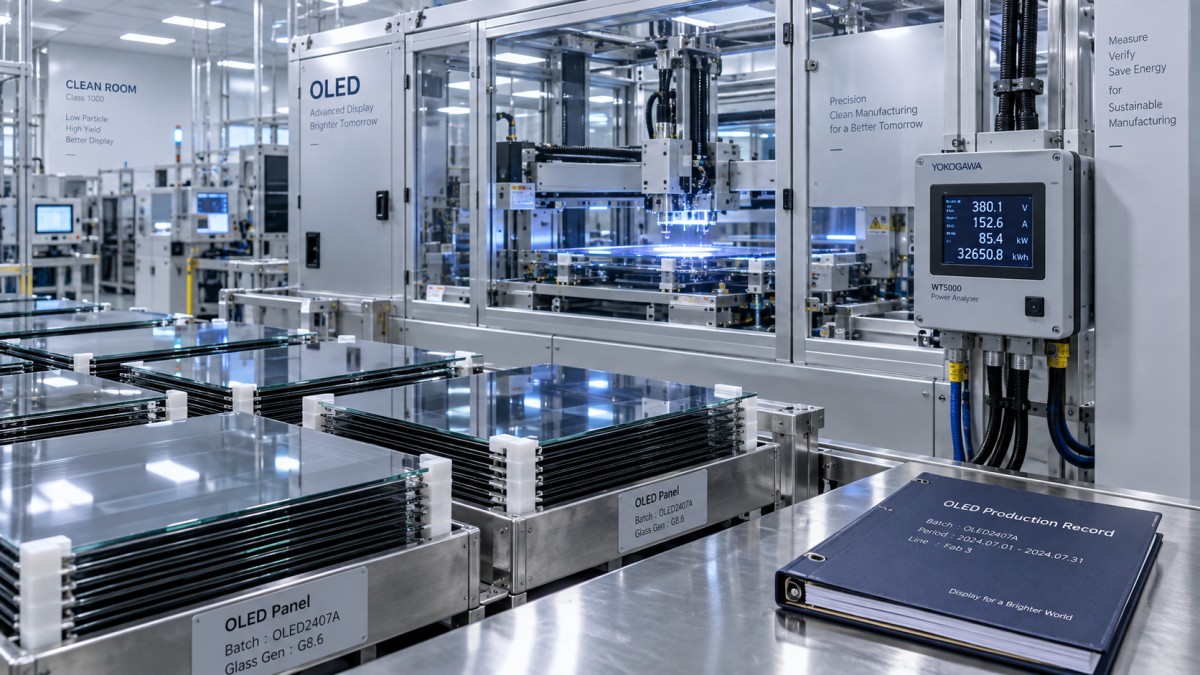
For an OLED module, distinguish panel fabrication from later module assembly. Depending on the product and supply arrangement, backplane fabrication, OLED deposition, encapsulation, driver integration, and final assembly may take place at different locations. A report covering the assembly plant should not be treated as evidence that upstream panel manufacturing is also included.
Ask the supplier to map the proposed manufacturing route against the exact part number and revision. The useful response is not “manufactured within our group.” It identifies the legal operator, physical address, and process performed at each relevant site. If production has not yet been allocated, request the candidate sites and make final allocation a disclosure requirement before shipment.
Commercial confidentiality is a legitimate concern, but it does not remove the verification problem. A controlled disclosure under a confidentiality agreement, or review by an agreed independent party, can sometimes provide the necessary evidence without circulating sensitive process information widely.
Request a compact evidence pack
- The order or part reference, manufacturing-site address, and operating legal entity.
- A route showing which production stages occur on-site and which are outsourced.
- The emissions reporting period and the inventory’s organizational and operational boundaries.
- A site schedule, inventory extract, or signed mapping connecting the producing factory to the reported data.
- Any assurance statement, including its scope, exclusions, and covered reporting period.
- The supplier’s method for notifying buyers about site transfers or subcontractor changes.
This is usually more useful than asking for every environmental document the supplier possesses. A large document bundle can still leave the central question unanswered.
Check what “covered” actually means
A factory can belong to the supplier’s corporate group yet fall outside a particular inventory boundary. Under the GHG Protocol Corporate Standard, organizational boundaries can be established using equity share or control approaches. The approach matters for joint ventures, leased operations, and facilities whose ownership changed during the reporting year.
Read the methodology and entity list together. If the report names only regional totals, ask for an explicit mapping between the factory and the consolidated inventory. A written confirmation can establish inclusion, but it does not turn a regional total into a factory-specific measurement.
Also check the operational boundary. Scope 1 addresses direct emissions from sources owned or controlled by the reporting organization; Scope 2 addresses purchased electricity, steam, heat, and cooling. Outsourced manufacturing may appear in Scope 3 rather than the supplier’s Scope 1 and Scope 2 figures. Where it appears depends on the actual commercial arrangement and reporting approach.
Keep greenhouse gas accounting separate from broader environmental compliance. An inventory expressed in carbon dioxide equivalent does not, by itself, establish compliance with air-pollutant limits, wastewater requirements, or chemical-handling rules.
Match the reporting year to the production conditions
Annual reporting inevitably creates a time lag. The latest published inventory may predate the line making your order, a capacity expansion, or a transfer to another site. That does not automatically invalidate the data, but it changes what you can reasonably claim from it.
Request a change statement covering the interval between the inventory period and expected production. Relevant changes include new production lines, altered electricity sourcing, significant utilization changes, and shifts between internal and outsourced processes. Where changes are material, ask for an updated estimate or explain the limitation in your assessment.
Electricity deserves particular attention. If both location-based and market-based Scope 2 figures are reported, keep them clearly distinguished. A corporate renewable-electricity statement should not be applied automatically to every factory. For a site-specific claim, check the relevant contractual instruments, their allocation, and whether they satisfy the applicable accounting criteria.
Do not insist on batch-level utility measurements where the plant has no credible means to produce them. Annual site data may be adequate for supplier screening. It is weaker evidence for a precise claim about a new product running on a different line.
Factory coverage is not an order-level carbon footprint
Even after confirming the factory, another question remains: how much of its emissions belongs to the OLED product you are buying?
Dividing annual factory emissions by total units shipped can be misleading when products differ in panel area, process route, yield, or equipment requirements. Shared cleanroom utilities also need an allocation method. Depending on the available data, process time, production area, metered energy, or another justified basis may provide a more defensible allocation than simple unit count.
Ask how the calculation handles scrap, rework, shared utilities, and upstream materials. Check whether the declared unit is one panel, one complete module, or a unit of display area. Two figures labeled “carbon footprint” are not necessarily comparable if one covers factory operations only and the other includes upstream materials and transport.
ISO 14064-1 addresses organization-level greenhouse gas inventories, while ISO 14067 addresses product carbon footprints. A reference to either standard is not enough on its own: examine the actual study boundary and supporting records. Likewise, IATF 16949 or ISO 26262 documentation can be relevant to automotive supply qualification, but neither establishes emissions coverage.
Treat assurance with the same care. Read what was checked, at what assurance level, and with which exclusions. A verified corporate total does not automatically mean an individual factory total or product allocation was separately verified.
Use the evidence gap to set purchasing conditions
Missing site-level data is not automatically a reason to reject a technically suitable OLED supplier. The response should depend on the intended claim, contract requirements, and consequences of getting the assessment wrong.
For preliminary supplier screening, a corporate inventory with transparent limitations may be sufficient. For comparing competing factories, seek site-level figures prepared on consistent boundaries. For customer-facing product claims or purchased-goods accounting, require a suitable product calculation or clearly documented estimation method rather than presenting corporate totals as order-specific evidence.
Record the result as confirmed, partially supported, or unresolved, with a reason. “Confirmed” should mean that documents connect the order’s manufacturing route to the relevant inventory—not merely that the supplier answered yes.
For future orders, include disclosure and change-notification obligations in purchasing documents. Define which manufacturing stages must be identified, when evidence is due, and what happens if production moves. Site transparency is much easier to negotiate before allocation than after finished modules arrive.
The specialty-chemical parallel: evidence before release
When specialty chemicals arrive outside their specified storage temperature limits, the practical response is to hold them from use, preserve temperature and shipment records, and obtain a documented disposition from the supplier and responsible quality or technical function. Check the product-specific requirements, excursion duration, actual exposure, packaging condition, and any available stability evidence. Follow the safety data sheet for safe handling.
A temperature excursion does not universally mean the material must be discarded, and returning it to the specified temperature does not prove its properties are restored. The decision depends on the material and evidence. OLED emissions review follows the same discipline: a reassuring general statement cannot substitute for records tied to the actual production route.
Close the review with a traceable answer
Within G-MDI’s cross-industry benchmarking context, linking Chinese high-tech manufacturing capacity with international ESG requirements calls for separating technical qualification from environmental evidence. An OLED module can satisfy its performance requirements while its manufacturing-site emissions remain insufficiently documented. Those findings should remain distinct.
Before approving an emissions claim, put one sentence in the procurement record naming the producing factory, inventory period, covered scopes, and remaining exclusions. If that sentence cannot be written without assumptions, request the missing site mapping or restrict the claim. The useful outcome is not a thicker sustainability file; it is an answer another reviewer can trace back to the factory making your order.
Facing technical bottlenecks in manufacturing or looking for more efficient industrial solutions? Leave your details below and let the engineering experts at G-MDI solve them for you.
We respect your privacy. Your information is strictly confidential.
Recommended News
- Logic & Memory ICs (7nm/sub-7nm)Indian Minister Calls for Domestic Semiconductor Machinery and Precision ComponentsIndia’s semiconductor machinery and precision components push could reshape sourcing. Discover what the minister’s call means for suppliers and buyers.
- Logic & Memory ICs (7nm/sub-7nm)Automotive Technology Platforms in North America: What Do They Offer?Explore what an automotive technology platform in North America offers, from connected vehicles and EV charging to software, safety and deployment.
- Logic & Memory ICs (7nm/sub-7nm)GlobalFoundries Breaks Ground on $10 Billion New York Semiconductor FabGlobalFoundries breaks ground on a $10 billion New York semiconductor fab. Explore its planned 2029 production and potential supply chain impact.
- Industrial Smart WearablesIndustrial Smart Wearables: How to Evaluate Safety and ConnectivityIndustrial Technology Information Platform insights help you evaluate smart devices for workplace safety, connectivity and reliable response. Explore the guide.
- Logic & Memory ICs (7nm/sub-7nm)Samsung Starts Onyang HBM Packaging Plant, Moving Production Up to 2028Samsung's Onyang HBM packaging plant targets mass production in June 2028. Explore what the accelerated schedule could mean for suppliers and buyers.
- Logic & Memory ICs (7nm/sub-7nm)Choosing a Telecom Infrastructure Monitoring Platform: Key Evaluation CriteriaCompare telecommunications infrastructure platform monitoring solutions by coverage, interoperability, security, scalability, and real-world performance.